

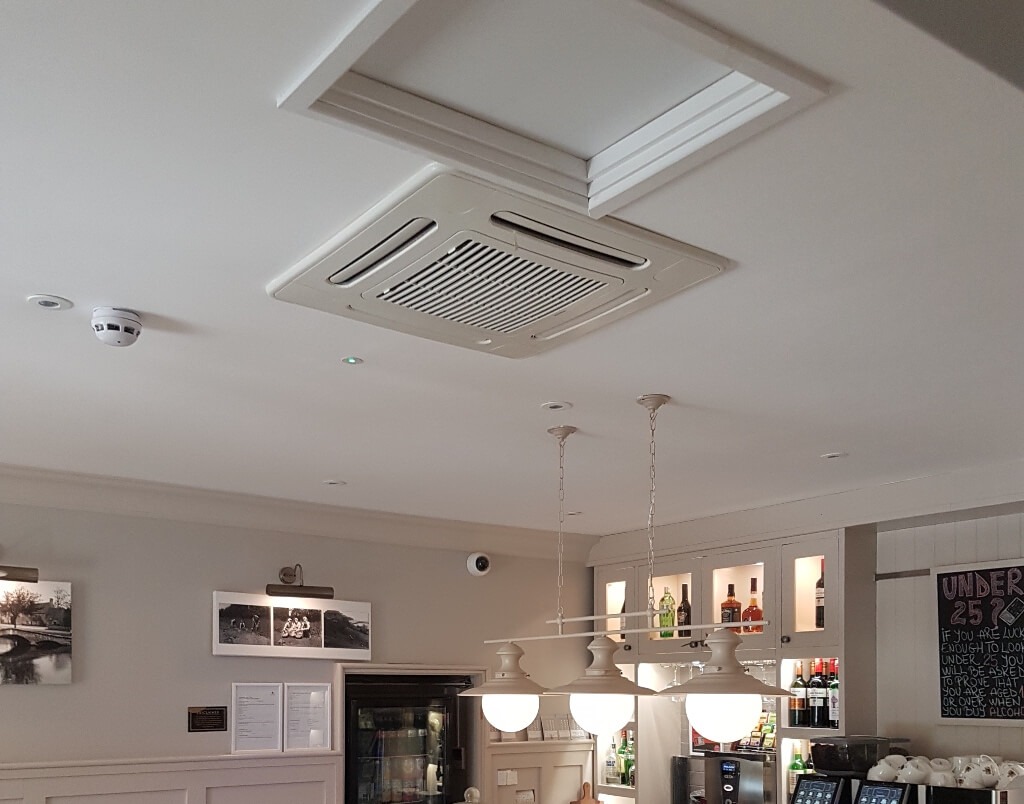
HVAC is the all-in-one solution helping to create the perfect temperature across the entire premises. With Heating, Ventilation and Air Conditioning (HVAC), this device is revolutionising commercial heating, maintaining a comfortable temperature all year long. However, to provide ventilation, HVAC filters are needed.
What Are HVAC Filters?
HVAC air filters are a crucial part of HVAC systems, as they allow for unwanted air particles to become trapped in their fibrous material. Consisting of a plastic or metal frame that supports a gauze-like piece of material, they are able to remove pollutants to improve the air quality within a workplace.
Depending on the environment or industry in which the HVAC system is installed, the pollutants will vary. However, HVAC filters are capable of removing anything from gases and odours to larger particles of debris.
There are many different types of HVAC filters, all offering unique ways of filtering air. Some systems will require the gauze filter to be washed after a period of time, removing any pollutants that are clogging the filter. Whereas other HVAC systems will need their filters replaced entirely. Ensuring your HVAC filters are properly installed and maintained is incredibly important, as problems here will affect the smooth running of the entire system.
Why Are Filters So Important To HVAC Systems?
Without a properly-maintained HVAC filter, an HVAC system will fail to deliver on its ventilation capabilities. These systems are able to control and improve the indoor air quality of a workplace. HVAC systems can dilute and displace air pollutants, allowing fresh outdoor air in and filtering particles out. When combined with the heat and cooling characteristics, HVAC systems are able to maintain a healthy and comfortable environment for all workers.
It may come as some surprise, but the ventilation function of HVAC systems is incredibly important to places of work. Without proper ventilation, employees are trapped within stale air throughout the duration of their shift. If your business involves manufacturing or industrial processes, this air will become increasingly polluted over the course of the day as odours, mould, and contaminants build up.
By circulating this air and removing these pollutants, it is possible to maintain a fresh environment for your workers, which will help to improve their motivation and productivity. Therefore, choosing the right HVAC filters for your system is crucial.
Main 7 Types of HVAC Filters
HVAC systems use a variety of filter types, each designed to target different pollutants and performance needs. Here are the top 7:
- Fibreglass Filters: Basic, disposable options designed to capture larger particles.
- Pleated Filters: Increased surface area improves overall particle-trapping efficiency.
- HEPA Filters: High-efficiency filtration, removing 99.97% of particles 0.3 microns and larger.
- Electrostatic Filters: Use static charge to attract and hold airborne particles.
- Carbon Filters: Activated carbon layer targets odours, VOCs, and gaseous contaminants.
- UV Filters: Use ultraviolet light to neutralise microorganisms like bacteria and mould.
Washable Filters: Reusable designs that reduce waste and offer long-term cost savings.
Know Your Filters: The Classifications Of HVAC Filters
To make it easier for businesses to establish which HVAC filter their system requires, air filters are graded, offering a guide on the size of particles each can remove. The classification has recently changed from the BS EN 779 filter rankings to the new ISO 16890.
Up until June 2018, the three BS EN 779 categories were used to determine how capable an HVAC filter is in removing particles. Using an average arrestance reading – the measure of an air filtration device’s ability to remove large, heavy particles from the air – the categories were determined as follows:
- Coarse (G) – Capable of 50-65% arrestance (G1) to 90% arrestance (G4), e.g. a G4 filter is created to capture pollen, fog and coarse dust, as well as textile fibres, insects, leaves, ash and sand.
- Medium (M) – An arrestance ranging from 40%-60% (M4) and 60%-80% (M5), these filters can remove mould, textile dust, skin flakes, yeast and bacteria.
- Fine (F) – Capable of a 35% minimum efficiency at 80%-90% arrestance (F7) and over 95% arrestance with a minimum efficiency of 70%.
Please note, BS EN 779 tests a filter’s performance against a particle the size of 4µm (micrometres). Moreover, the minimum efficiency was determined by the lowest percentage during all three steps of the filter installation cycle.
The legislation was updated to take into consideration that real-life particles do not have a uniform shape of 4µm. Only testing HVAC filters with this size of particulate matter was simply not realistic. Therefore, ISO 16890 tests HVAC filters differently. The new classification is decided on the filter’s ability to remove particles ranging from 0.3µm to 10µm, including the danger zone (particles which are too small for the body to protect itself).
After more realistic testing, air filters are now ranked on their efficiency to remove particles with a diameter less than:
- 10µm
- 2.5µm
- 1µm
- ISO Coarse
UK Building Regulations for Commercial HVAC Filtration
Commercial buildings must comply with standards found in:
- Building Regulations Part F (Ventilation): Requires adequate air quality and filtration for mechanical ventilation systems.
- CIBSE Guidelines: Recommend filtration appropriate for occupancy type, pollution levels, and ventilation strategy.
- Employer HSE Obligations: Ensure safe indoor air quality in workplaces, especially in high-contaminant industries.
Including these enhances the relevance for UK commercial facility managers and building engineers.
Brexit Implications for Filter Standards and Imports
While the UK continues to recognise ISO 16890, Brexit has led to:
- Divergence in product conformity labels (UKCA vs. CE) for imported filters.
- Potential import delays or additional compliance checks for EU-manufactured products.
- Increased importance of UK-based certification to ensure filters meet safety and performance standards.
Understanding MERV Ratings for Different Filter Types
Top industry resources consistently highlight MERV ratings as a key factor in choosing the right HVAC filter. MERV (Minimum Efficiency Reporting Value) measures a filter’s ability to capture particles of different sizes. Here’s a simplified breakdown to help readers match MERV levels with filter types and applications:
- MERV 1-4: Basic protection, typical of fibreglass filters. Suitable for capturing large particles like dust and lint.
- MERV 5-8: Standard pleated filters are used in most homes. Capture smaller particles, including mould spores and pet dander.
- MERV 9-12: Superior residential filtration. Effective for finer particulates such as lead dust and auto emissions.
- MERV 13-16: High-performance filtration comparable to hospital-grade systems. Suitable for medical facilities and high-sensitivity environments.
Different Types Of HVAC Filters

Similarly to their being different types of HVAC systems, there are also different types of HVAC filters. The main variations lie in the material used for the filter and what they are specifically designed to achieve. For example, a filter with a charcoal element can remove odours, whereas a pleated filter is able to prevent dust and debris from entering the HVAC system.
Discover the extensive range of HVAC filters that are available.
Panel Filters
A common form of HVAC filter, Panel Filters can act as a pre-filter or final filter. The reloadable framework that forms the panelling is able to hold a range of different filters, including synthetic plastic, carbon and glass fibre.
Washable Air Filters
Washable Air Filters have reloadable frames that allow for a reusable filter to be inserted. These filters are often made from reticulated foam, allowing them to withstand machine washing. For these filters to remain effective in their ability to remove particles, regular washing is needed.
Electrostatic Air Filters
These air filters focus on removing 80-90% of dust, pollen, bacteria, smoke and mould from working environments using static electricity. Electrostatic Air Filters use layers of polyurethane and polypropylene alongside filtration media, generating static electricity from the friction of the air passing through the filter. As they are effective in removing such small particles, they are often recommended to allergy sufferers.
Pleated Filters
Pleated Filters are recognisable by the folder pattern of their filter media, often a pliable polyester, cotton or paper. This unique design allows for the surface area of the filter to be significantly increased, while also increasing its ability to capture large particles. These filters can often last around 90 days before needing to be replaced; however, this will, of course, vary depending on the business’s environment and the time of year. But, in most cases, pleated filters are less likely to clog up in short periods.
Glass Fibre Filters
Glass Fibre Filters are known for having a high dust-holding capacity due to their composition of lofted glass fibre. This filter media is then specially manufactured to provide a graduated density, which allows for an effective ability to capture dust particles. The filter itself is then fitted to a moisture-resistant frame within the HVAC system.
Synthetic Filters
Synthetic disposable filters provide a non-glass-fibre alternative, which is typically specified in the food and catering industries. These coarse filters allow for low resistance, high dust-holding ability and fairly high levels of cleanliness.
Bag Filters
HVAC systems have the option to include Bag Filters in their workings. These HVAC filters are also known for their dust-holding properties, without increasing the air resistance within the system. But, before you can choose to implement Bag Filters, you must first assess whether you need Semi-Rigid or Rigid Bag Filters.
Semi-Rigid Bag Filters
Semi-Rigid Bag Filters use synthetic filter media to create pockets of air filter across the surface of the filter. Similar to Pleated Filters, the numerous pockets increase the filter’s surface area, improving the efficiency of the system’s ventilation filtration. The flexible synthetic material is often secured to a metal frame, adding some rigidity to the design.
Rigid Bag Filters
Rigid Bag Filters, similarly, have filter media arranged into air pockets, but each individual pocket forms a rigid funnel. Unlike semi-rigid designs, where each pocket is flexible and only fixed at the opening, rigid pockets are all secured to a frame. The additional structure, along with the depth of each pocket, enables the filter to be resilient to any damage occurring to the media during installation.
Fan Coil Filters
These filters use filter media made of non-woven polyester, a material that can remove dust particles when vacuumed. In Fan Coil Filters, the media is sewn onto copper-coated wireframes, with cross braces where necessary. An extremely lightweight filter, it can be cleaned, washed and reused, offering a cost-effective option for HVAC systems.
Grease Filters
For businesses that are looking to improve the air quality in environments where grease is present, Grease Filters have been specially designed to target the removal of grease and cooking oils; however, there are two methods to choose from.
Mesh Type Grease Filters
A Mesh Type Grease Filter works by directing air through a crimped knitted wire pad commonly made from galvanised steel, but aluminium and stainless steel options are available. This design is extremely robust and built for longevity. To ensure its long lifespan, intense cleaning is required.
Baffle Grease Filters
Baffle Grease Filters involve baffles that are specially designed devices that can restrain the flow of gases. By combining interlocking baffles, two rigorous interchanging airflows are created, and the air direction changes 180 degrees in both. Grease molecules can withstand a greater inertial force than air; therefore, the violent airflow that is created is able to separate these molecules. The removed grease molecules are then directed into stainless steel vanes within the frame.
HEPA Filters
High-Efficiency Particulate Air (HEPA) filters are pleated, mechanical air filtration systems that are known for their ability to remove larger particles, such as pollen, dust mites and pet dander. However, it is worth noting that these filters are not as effective in removing smaller particles under 0.3µm. There are two types of HEPA filters to choose from: Deep Pleat and Mini Pleat.
Deep Pleat
Deep Pleat HEPA Filters are designed to provide air intake and extraction where a high level of efficiency is required. Deep Pleats, therefore, are able to offer submicron-level protection, working at high pressure.
Mini Pleat
Whereas Mini Pleat Filters offer low-cost options for HEPA filtration systems, as they can function at a lower pressure than Deep Pleats. However, filter media installed in mini pleats are more suitable for use in hospitals and certain scientific laboratories.
Carbon Filters
Carbon Filters are effective in removing unpleasant and dangerous gases and odours from the air. Activated carbon is able to absorb chemical molecules. However, depending on the pollutants that are being targeted, the dwell time of particles within the filter must be considered. If harmful gases are removed and stored in the filter, these filters may require more frequent cleaning or replacing.
UV Filters
UV Filters use ultraviolet energy to remove microorganisms from the air, including bacterial, fungal and viral organisms. Its ability to remove germs comes from the involvement of short-wave ultraviolet light (UV-C) to inactivate these airborne pathogens. When built into an HVAC system, the UV-C waves can be contained at a safe distance away from workers.
Visual Filter Identification Guide
A clear visual guide helps homeowners and facility managers quickly recognise different HVAC filters at a glance. Following the visual approach used by ECI Comfort, include labelled images or diagrams that highlight the defining features of each filter type.
Recommended visuals to include:
- Fibreglass Filters: Thin, blue/white mesh with a simple cardboard frame.
- Pleated Filters: Accordion-style pleats, usually white with a wire backing.
- HEPA Filters: Thick, dense media in a rigid frame; often deep-set.
- Electrostatic Filters: Washable plastic or metal mesh grids.
- Carbon Filters: Dark appearance due to the activated carbon layer.
- UV Filters: UV lamp units placed within ductwork (paired with another filter type).
- Washable Filters: Reusable metal or plastic frames with rinseable mesh.
Maintaining HVAC Filters
As with any air conditioning system, to ensure your system is working as effectively and efficiently as possible, regular maintenance is necessary. And, for HVAC systems that include regular maintenance of the filters. If your HVAC filters require cleaning, ensure your business has enough spares to implement a cleaning rotation. Alternatively, with other types of HVAC filters, arranging for qualified professionals to clean the systems will only improve the entire system’s performance.
If an HVAC system’s filters are not properly looked after, they can have an adverse effect on the air quality in your workplace. Dirty or clogged filters will be unable to effectively remove particles, leaving possible harmful contaminants in the air, whilst also creating a stuffy atmosphere. While the HVAC system’s efficiency plummets, so will your members of staff’s level of productivity.
On a more serious note, if there was a fault or a filter had been improperly fitted after cleaning, the health of your HVAC system could be compromised. This could cause other aspects of your HVAC system to overheat or break down, leading to avoidable repair jobs. To avoid this fate, it is recommended to arrange at least 4 services a year for your HVAC system, including checks and general maintenance of the filters.
At PRA Air Conditioning, our expert engineers are on hand to offer thorough maintenance and servicing of HVAC systems, not forgetting the HVAC filters. Our services span across the UK, from the South West of England and South Wales, including the Midlands, in particular Birmingham, Coventry and Staffordshire. For more information about the HVAC filters in your workplace, contact our professionals today.